Chapter 08 · 1949–1978
Red China
“Red China” was not a stable description of the People’s Republic. It was a relational American frame that changed with policy: wartime captions made an enemy, classified maps made an intelligence object, nuclear estimates made a strategic threat, and the 1972 opening made an interlocutor without dissolving ideological difference.
The People’s Republic of China was founded in 1949, but the United States continued to recognise the Nationalist government on Taiwan. The Korean War then turned political nonrecognition into direct combat. For two decades, restricted contact made China present to American officials and publics through military photography, maps, intelligence estimates, and the language of “Communist China.” By 1972, the same state could be photographed greeting an American president. This chapter follows that changing American archive; it does not claim to stand for the many domestic experiences of revolution, collectivisation, famine, political struggle, and social transformation inside China.
Evidence set6 objects · 1951–1972
Method noteThe sequence moves through four institutional acts: capture, mapping, estimation, and encounter. Each makes the People’s Republic visible in a different way. Together they show that “Red China” named a changing relationship more reliably than it described a country.
The evidence sequence
How an enemy became an interlocutor
Scroll through 4 surviving objects. The image changes as the argument advances from one frame to the next.
01 / Enemy
The wartime ally becomes the enemy
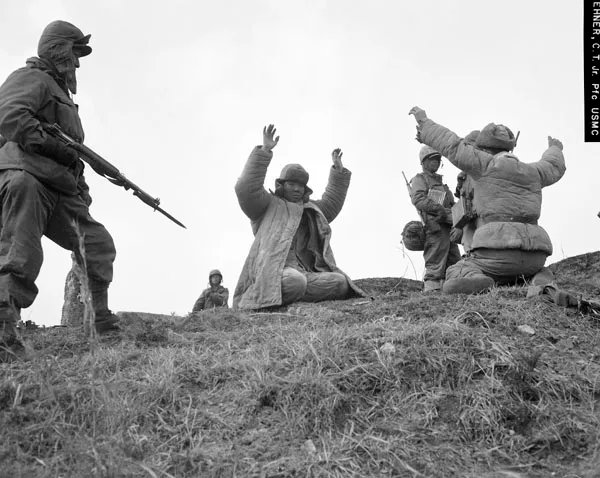
Less than a decade after American propaganda had called the Chinese soldier a friend, United States Marines were fighting Chinese forces in Korea. Pfc. C. T. Wehner’s photograph records prisoners captured near Hoengsong; its official caption identifies them not by unit or individual name but as “Chinese Communists.”
Close readingA Marine and his fixed bayonet occupy the left edge while two kneeling prisoners raise their hands against an empty winter sky. The low viewpoint turns surrender into a stark silhouette. The caption completes the classification: political identity replaces the wartime category of national friend.
Open source record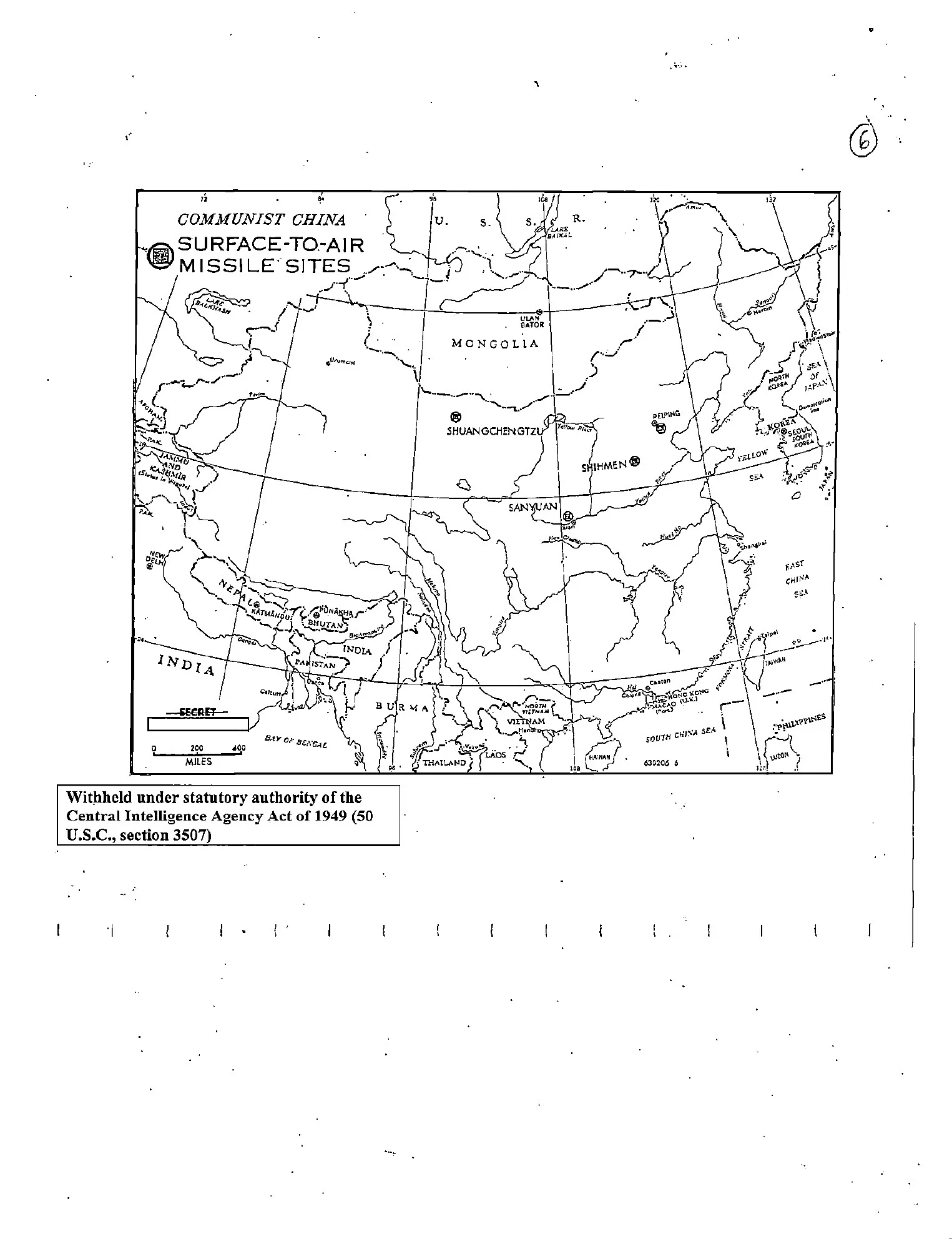
02 / Intelligence
Nonrecognition becomes a map
With little direct access to the mainland, the American state assembled China from aerial observation and classified reporting. A map enclosed in President Kennedy’s intelligence checklist plots eight known surface-to-air missile sites beneath the heading “Communist China.”
Close readingNational space is stripped to borders, cities, flight arcs, and target symbols. The map’s sparse black marks make a vast society legible as defensive capability, while the declassification box reminds us that even the evidence now visible was once organised by secrecy and withholding.
Open source record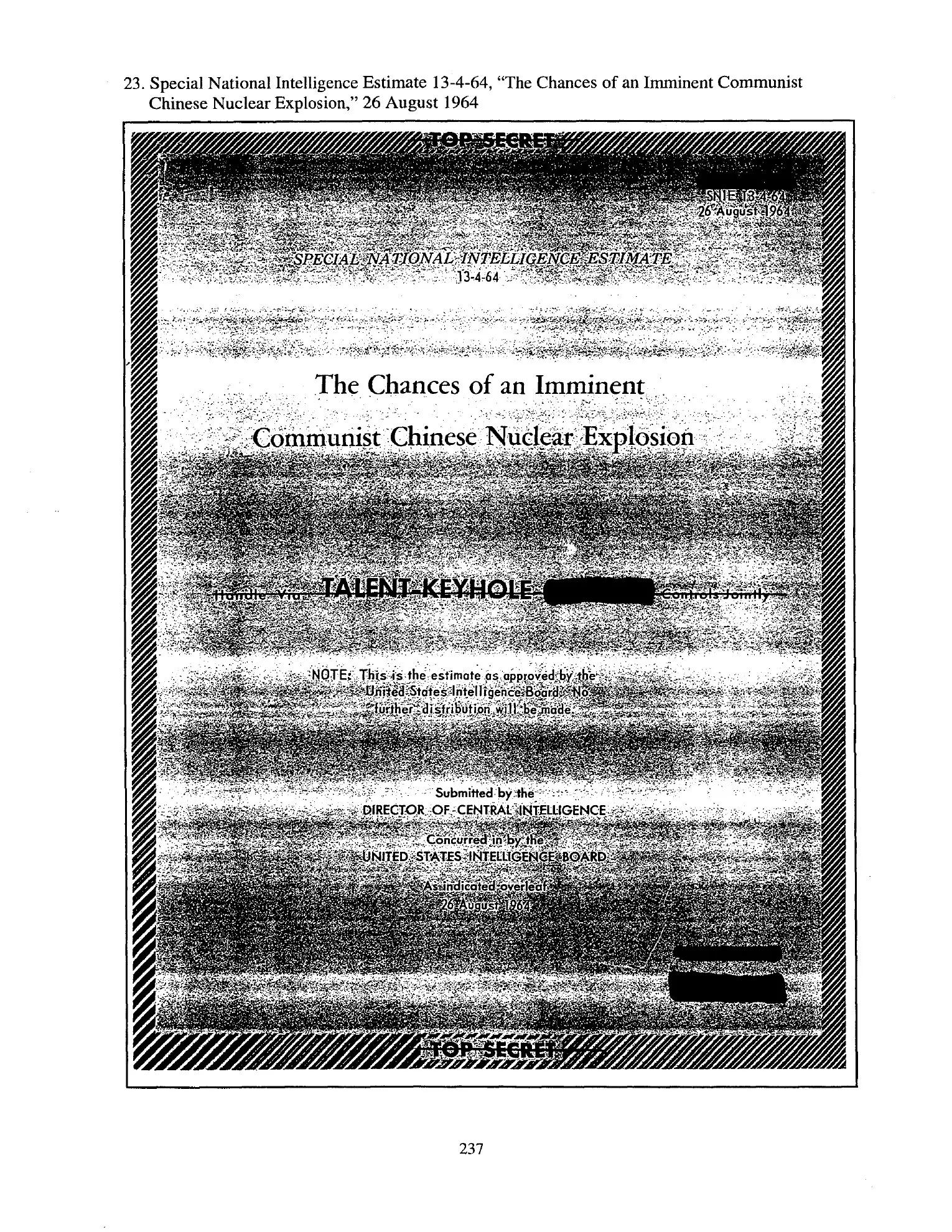
03 / Capability
Opacity becomes a forecast
In August 1964, a Special National Intelligence Estimate assessed whether construction at Lop Nor meant that China would soon test a nuclear device. The estimate could identify a probable test site, yet it remained uncertain about fissile material and timing. China detonated its first device less than two months later.
Close reading“The Chances of an Imminent Communist Chinese Nuclear Explosion” dominates a cover crossed by classification bands, codewords, and later redactions. The document’s visual authority is formidable, but its title announces probability rather than knowledge. China appears as a capability to be inferred from overhead images.
Open source record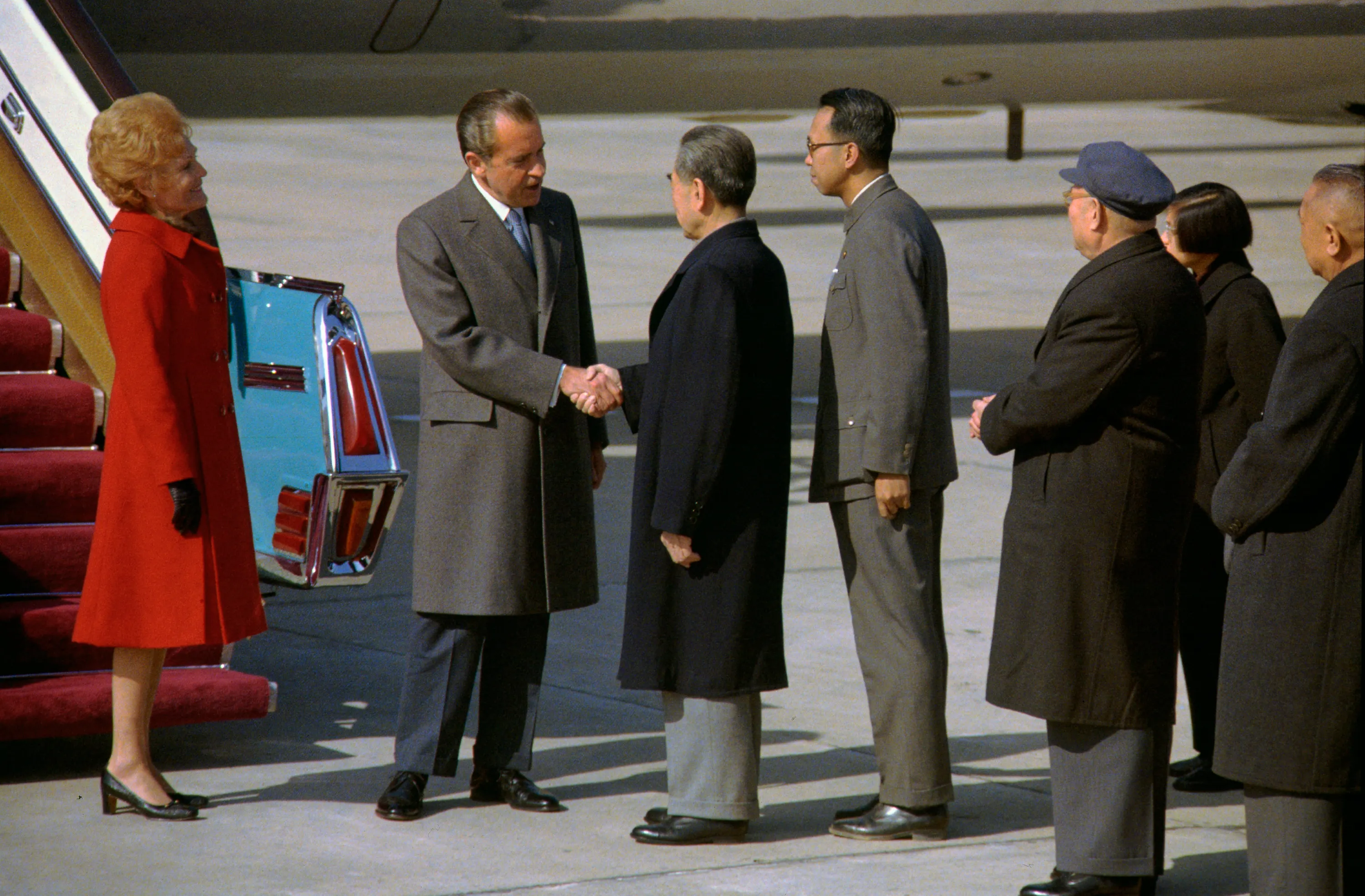
04 / Opening
The enemy becomes an interlocutor
President Richard Nixon’s arrival in Beijing on 21 February 1972 produced an image that reversed the visual grammar of two decades. Premier Zhou Enlai now stood at the foot of Air Force One to receive the leader of a government that still did not formally recognise the People’s Republic.
Close readingThe handshake is small but central, framed by an American aircraft, Pat Nixon’s red coat, and a receiving line of Chinese officials. Neither side disappears into the other. The photograph stages contact itself as the event: diplomatic proximity replaces the distant view of prisoner, map, and estimate.
Open source recordCounter-reading
The label organised policy; it did not explain China
“Red China” compressed a new state, a revolutionary project, and hundreds of millions of lives into an ideological colour. The American archive is valuable precisely because it exposes the institutions doing that compression—military captioning, intelligence collection, covert planning, and presidential image-making.
- 01The 1959 CIA memorandum does more than observe communes and unrest. It treats upheaval on the mainland and resistance in Tibet as possible openings for a joint programme with the Republic of China. Knowledge production and intervention appear on the same page.
- 02Missile maps and nuclear estimates record real security questions, but they render Chinese society mainly as locations, installations, and inferred capabilities. Their uncertainty is part of the history, not a defect that later hindsight should erase.
- 03The 1972 opening did not simply reveal a China that had been hidden. Both governments choreographed what visitors and cameras could see. At the Great Wall, an ancient civilisational landmark re-entered the frame alongside the Communist state, allowing strategic rapprochement to borrow the visual language of timeless China.
Evidence register
Sources in this chapter
- 01Men of the 1st Marine Division capture Chinese Communists at HoengsongPfc. C. T. Wehner, United States Marine Corps2 March 1951Chinese soldiers classified as a Communist battlefield enemy
- 02Communist China: Surface-to-Air Missile SitesCentral Intelligence Agency7 February 1963Mainland China reduced to observed defensive capability
- 03The Chances of an Imminent Communist Chinese Nuclear ExplosionDirector of Central Intelligence and United States Intelligence Board26 August 1964Chinese nuclear capability made into a problem of prediction
- 04President Richard Nixon and Premier Chou En-Lai shake hands on arrival in PekingByron Schumaker, White House Photo Office21 February 1972Diplomatic contact replaces the distant enemy image
- 05Joint CIA-GRC Resistance ProgramCentral Intelligence Agency27 March 1959Domestic upheaval interpreted as an opportunity for covert action
- 06President Richard Nixon looks at the view from the Great Wall of ChinaByron Schumaker, White House Photo Office24 February 1972Strategic opening staged through the landscape of timeless China