Chapter 05 · 1793–1839
The Closed Empire
Britain did not simply discover a closed China in 1793; anticipation, retrospective publication, and the politics of regulated trade made “closure” into a national character.
The Macartney Embassy asked the Qing court for a resident minister, new ports, storage facilities, and other changes to the terms of trade. Its demands were not granted. British accounts increasingly explained that outcome through a larger image—a proud empire enclosed by ritual, walls, and its own certainty. Restrictions were real, especially at Canton, but “the closed empire” converted a contested relationship into a claim about what China essentially was.
Evidence set6 objects · 1792–1830
Method noteThe sequence begins with a caricature published before the embassy reached China, then follows the audience, its official visual record, and the Canton waterfront. It reconstructs a frame being made, not a country withdrawing in four steps.
The evidence sequence
How a disagreement became a national character
Scroll through 4 surviving objects. The image changes as the argument advances from one frame to the next.
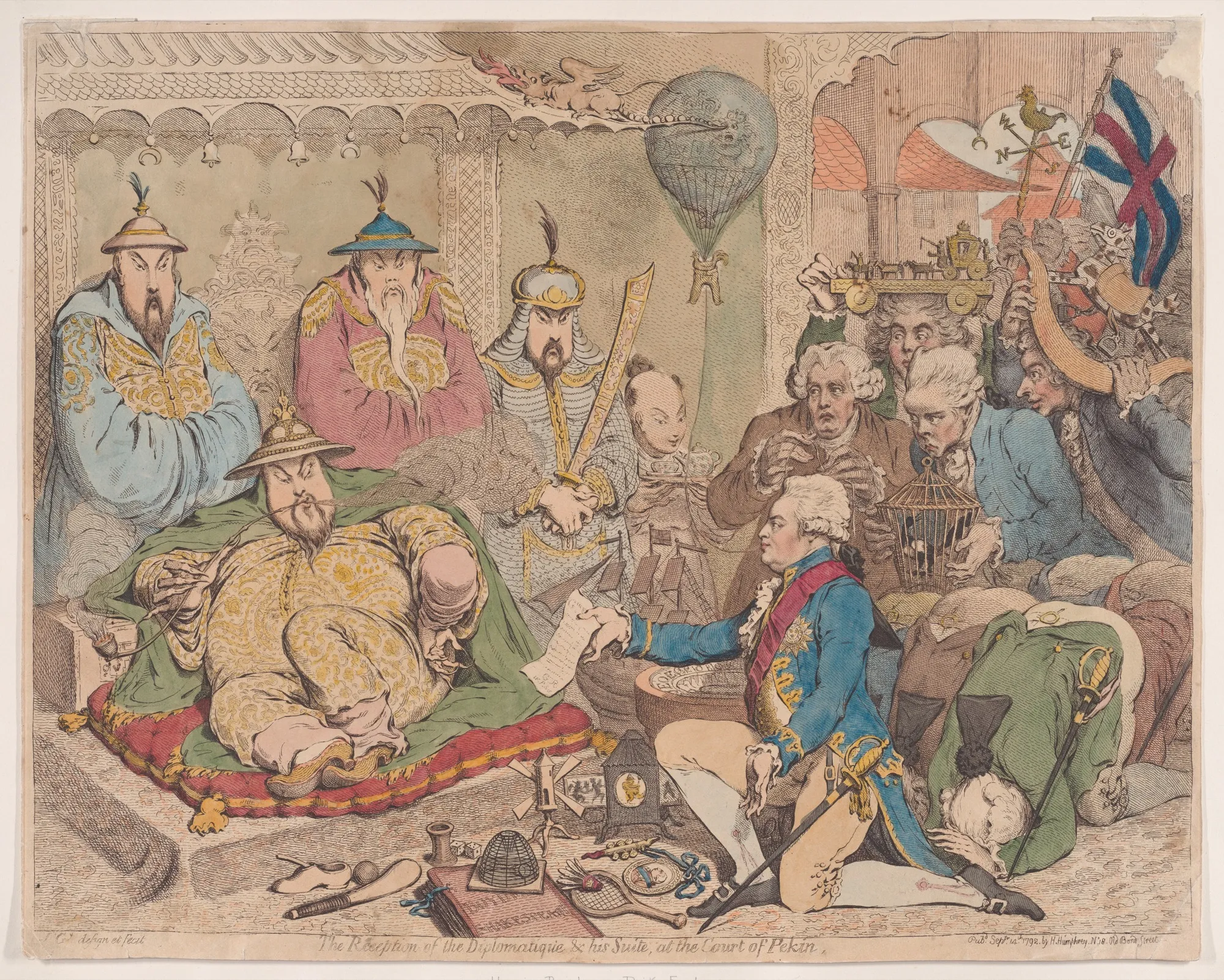
01 / Anticipation
The failure arrives first
James Gillray published his imagined reception of Lord Macartney in September 1792, before the embassy had reached China. The print already knew what the encounter would mean—British dignity humbled before an absurd, despotic court.
Close readingMacartney kneels amid prostrating diplomats and conspicuous gifts while the emperor presides over a theatrical jumble of bodies, architecture, and costume. Diplomatic ritual is made comic in advance; ridicule supplies an interpretation before experience can complicate it.
Open source record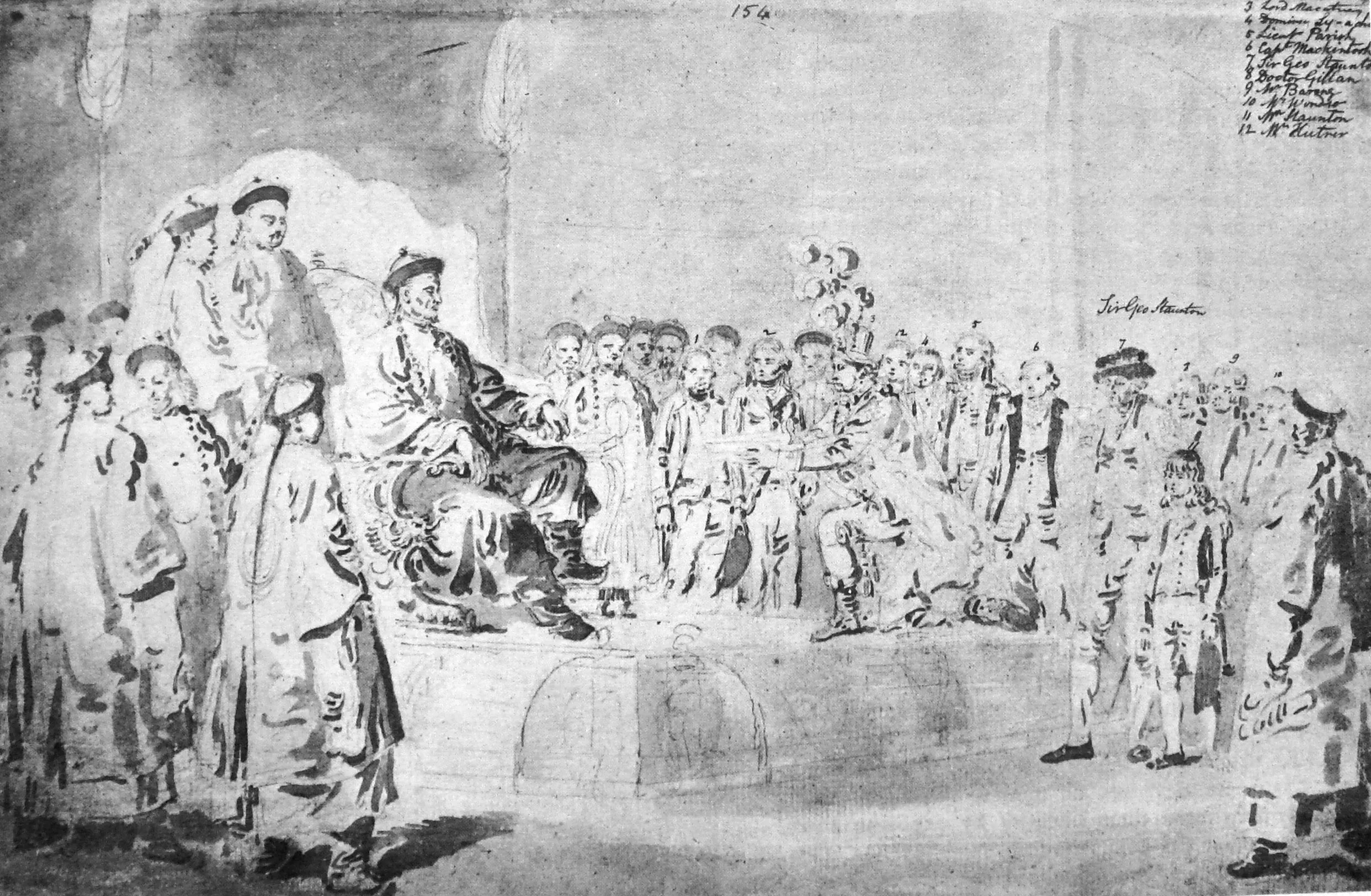
02 / Audience
An audience becomes a refusal
The embassy travelled across the empire and Macartney met the Qianlong Emperor at Rehe. Yet because its principal requests were denied, the encounter was increasingly remembered as a clash between British openness and Chinese refusal rather than as negotiation between incompatible diplomatic systems.
Close readingWilliam Alexander did not witness the audience. His reconstructed drawing gives it the authority of an observed event through a numbered key, ranked groups, and a clearly staged approach to the throne. The record is precise in appearance and retrospective in construction.
Open source record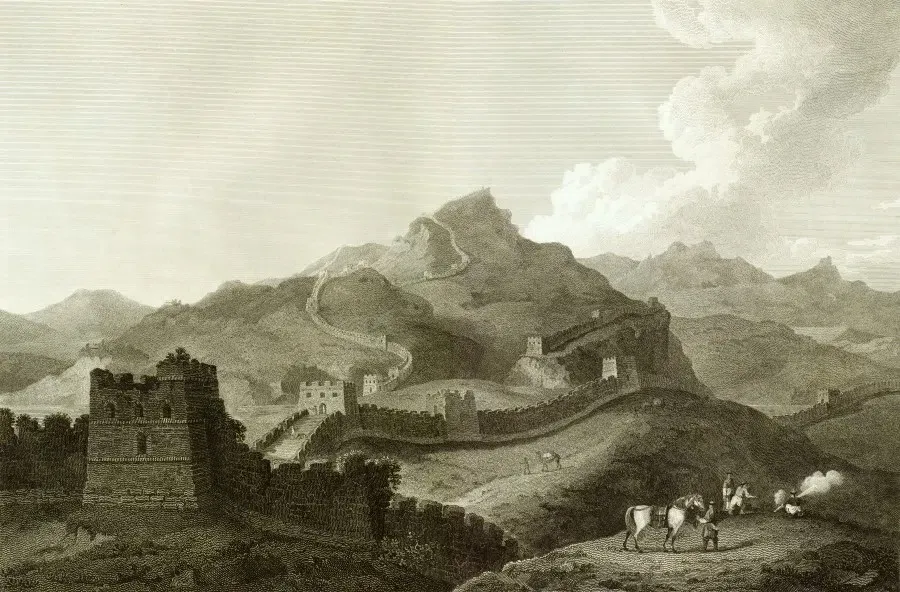
03 / Boundary
A journey becomes a wall
The official embassy account converted travel into organised knowledge—maps, costumes, buildings, ceremonies, and measured monuments. Its Great Wall plate offered readers a single, unforgettable boundary that could stand for the political character they believed the mission had encountered.
Close readingThe wall recedes across ridge after ridge while soldiers, animals, and observers occupy the foreground. Measurement makes the landscape knowable, but the monument remains vast and separating. Alexander had not seen it himself; a collaborative, second-hand image became an authoritative metaphor.
Open source record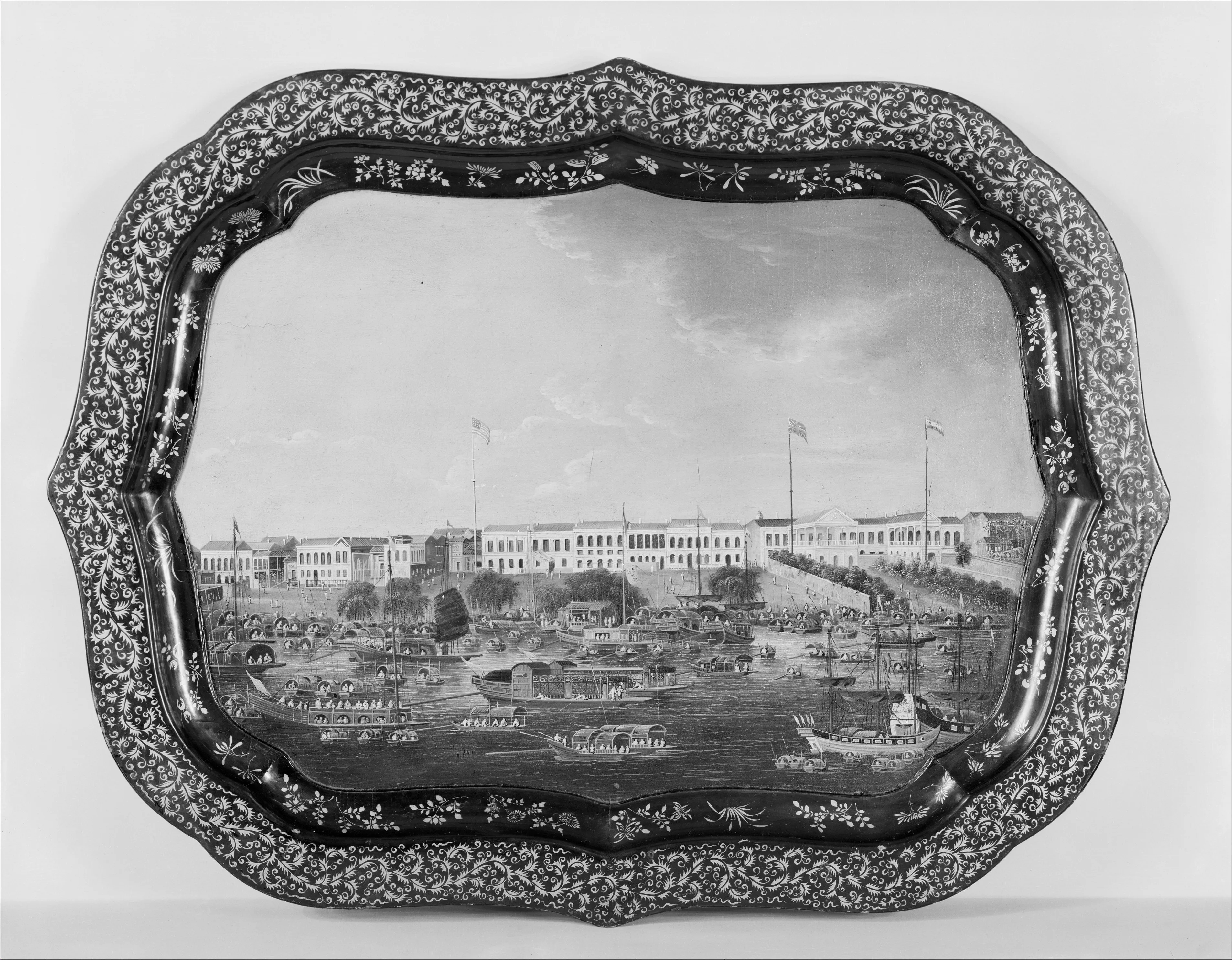
04 / Trade
Regulation becomes closure
Foreign trade at Canton was limited to a narrow waterfront and conducted through licensed merchants under close regulation. To British merchants seeking wider access, that managed geography looked like proof of an empire refusing ordinary relations with the world.
Close readingForeign factories line the river under national flags while small boats crowd the water. The strip is visibly confined, but it is also dense with movement, construction, and exchange. The image preserves both halves of the system that “closed” collapses into one.
Open source recordCounter-reading
A managed frontier was not a sealed country
Qing institutions controlled the terms of diplomacy and commerce without eliminating either. The label “closed empire” described British frustration with those terms while making Britain’s expanding demands appear universal and neutral.
- 01The Qing court received the embassy, permitted extensive travel, exchanged gifts, and conducted diplomacy within its own imperial order; the mission’s failure was not the absence of contact.
- 02The Canton system restricted where and through whom foreigners could trade, yet sustained an expanding, labour-intensive commerce in tea, porcelain, silk, and other goods.
- 03British requests for permanent representation, additional ports, storage, and territorial facilities emerged from an expanding maritime empire. Calling their rejection “closure” hid that asymmetry.
Evidence register
Sources in this chapter
- 01The Reception of the Diplomatique and his Suite at the Court of PekinJames Gillray; published by Hannah Humphrey14 September 1792Luxury fantasy turns diplomatic satire
- 02Macartney’s first meeting with the Qianlong EmperorWilliam Alexander, reconstructed from embassy testimony1793Diplomatic exchange remembered as refusal
- 03View of the Great Wall of China near GubeikouThomas Medland after William Alexander and Henry William Parish1796A surveyed frontier becomes a national metaphor
- 04Tray with the Canton factoriesUnknown Chinese makerearly 19th centuryRegulated trade appears as confinement
- 05An Officer of the Corps of BowmenWilliam Alexander1797–1805Encounter becomes a representative type
- 06Packing Porcelain in Canton for Shipment to the WestUnidentified Chinese artistca. 1830Closure contradicted by organised export labour