Chapter 04 · 1700–1793
Luxury China
Trade turned China into a portable language of European luxury—ordered from Chinese workshops, copied in European factories, and enlarged into rooms and landscapes.
During the eighteenth century, China reached European consumers through things that could be held, displayed, and inhabited. Porcelain and lacquer crossed oceans; European workshops imitated their materials; designers extracted figures and landscapes into reusable motifs. The resulting “China” was grounded in real exchange, but luxury made the relationship appear decorative, available, and easy to possess.
Evidence set6 objects · 1710–1792
Method noteThe sequence expands in scale—from a vessel to furniture, printed ornament, and a royal landscape. It follows the construction of a European taste, not a descent from authentic object to mere fantasy.
The evidence sequence
How an empire became a style
Scroll through 4 surviving objects. The image changes as the argument advances from one frame to the next.
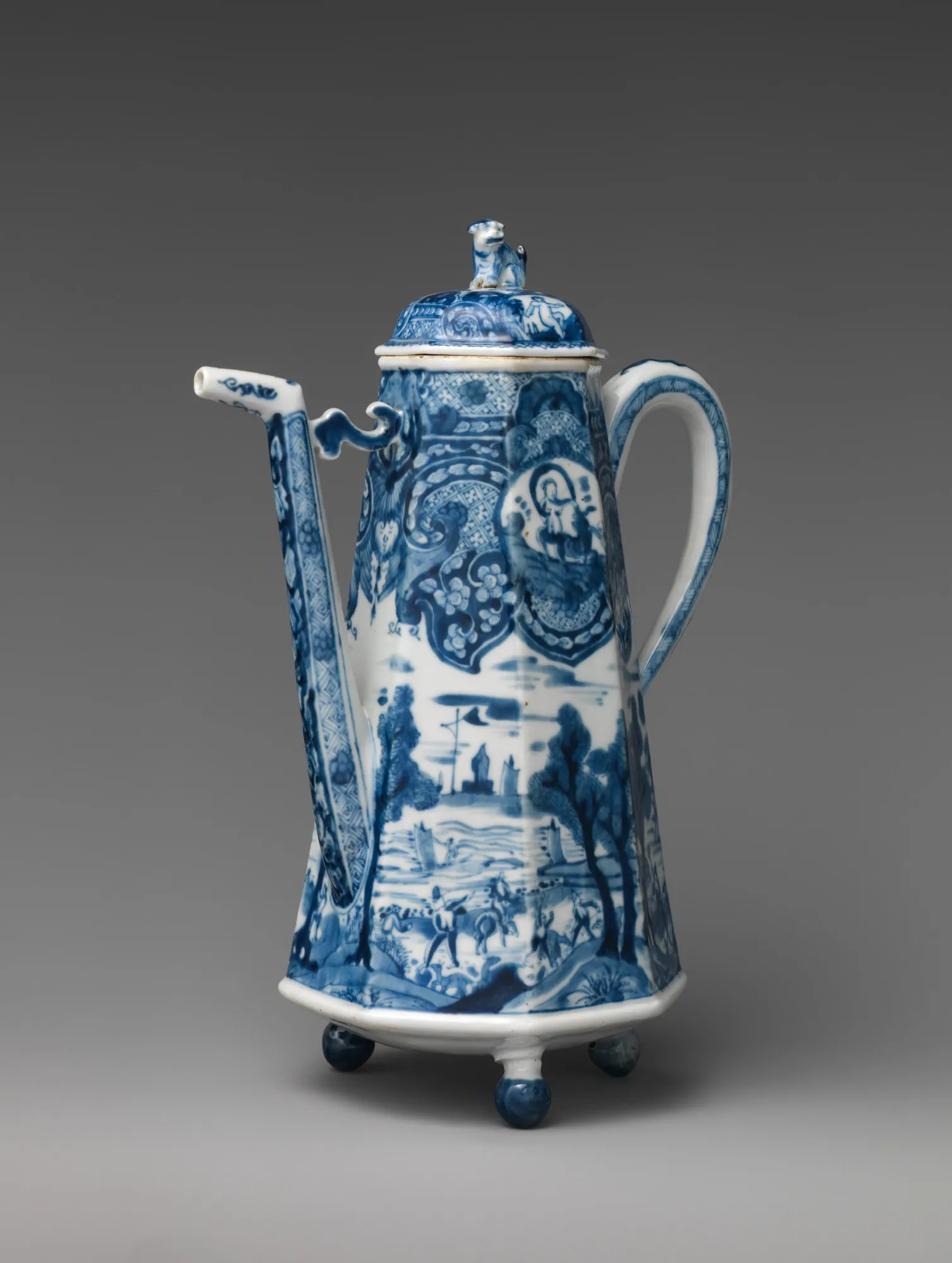
01 / Vessel
The order changes the object
Chinese porcelain makers produced this coffeepot for a European market, adapting a form associated with Dutch pottery and English silver. Export demand did not simply carry an unchanged Chinese object westward; it prompted workshops to translate foreign habits into porcelain.
Close readingThe tall, tapering body and angular spout answer a European coffee service, while underglaze-blue landscapes, patterned panels, and an animal finial make the vessel legible as prized “china.” Its mixed design records negotiation rather than one-way influence.
Open source record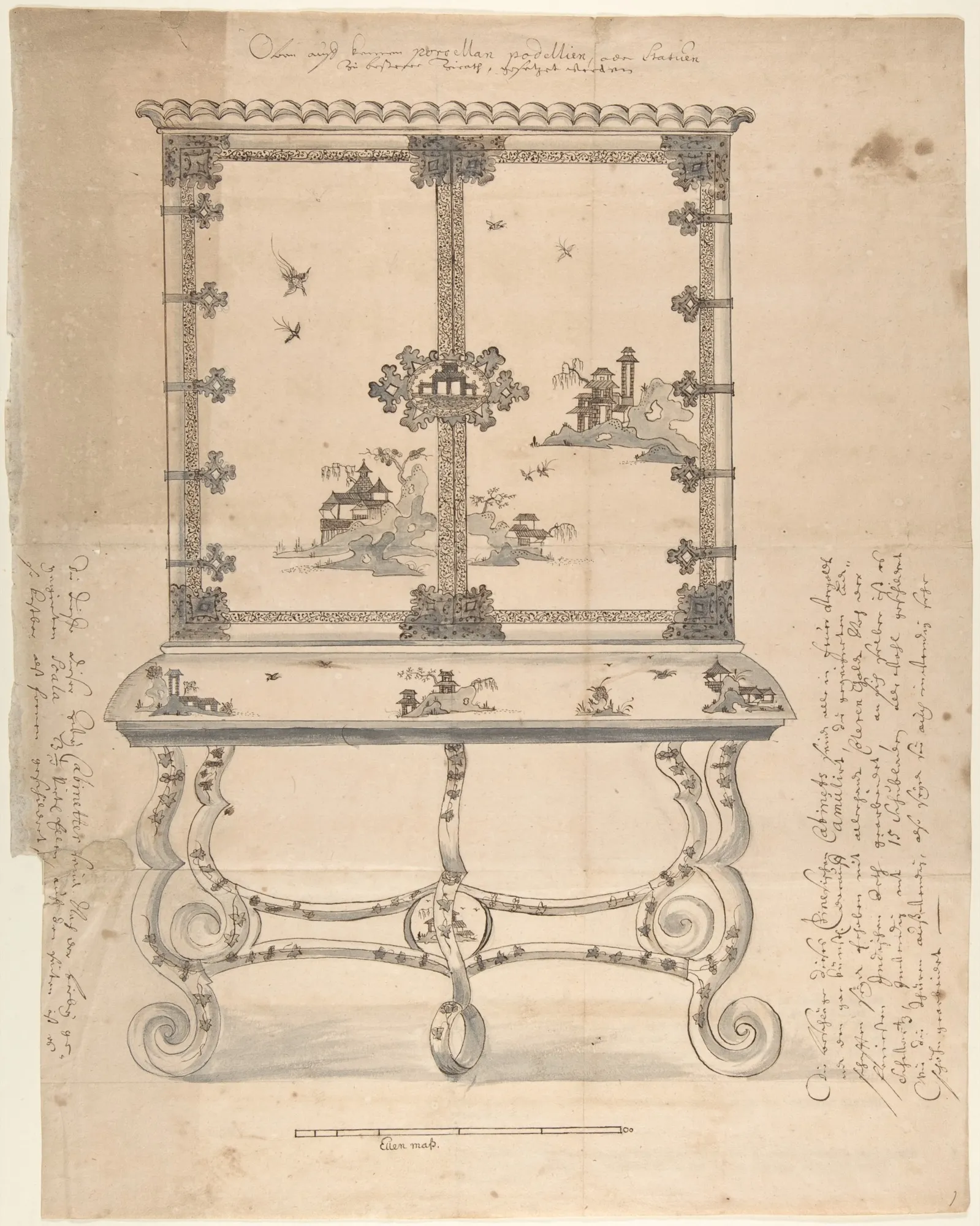
02 / Interior
The object becomes a room
In German-speaking Europe, imported Asian lacquer and local imitations became elite furnishings. This workshop drawing proposes a black-and-gold cabinet with fifteen decorated drawers, translating distant landscapes into a precise commission for a European interior.
Close readingMeasured scale, written instructions, hinges, mounts, and symmetrical doors surround miniature pavilions and rocks. Fantasy is organised as specification: “Chinese” scenery becomes a surface that can be priced, repeated, and installed.
Open source record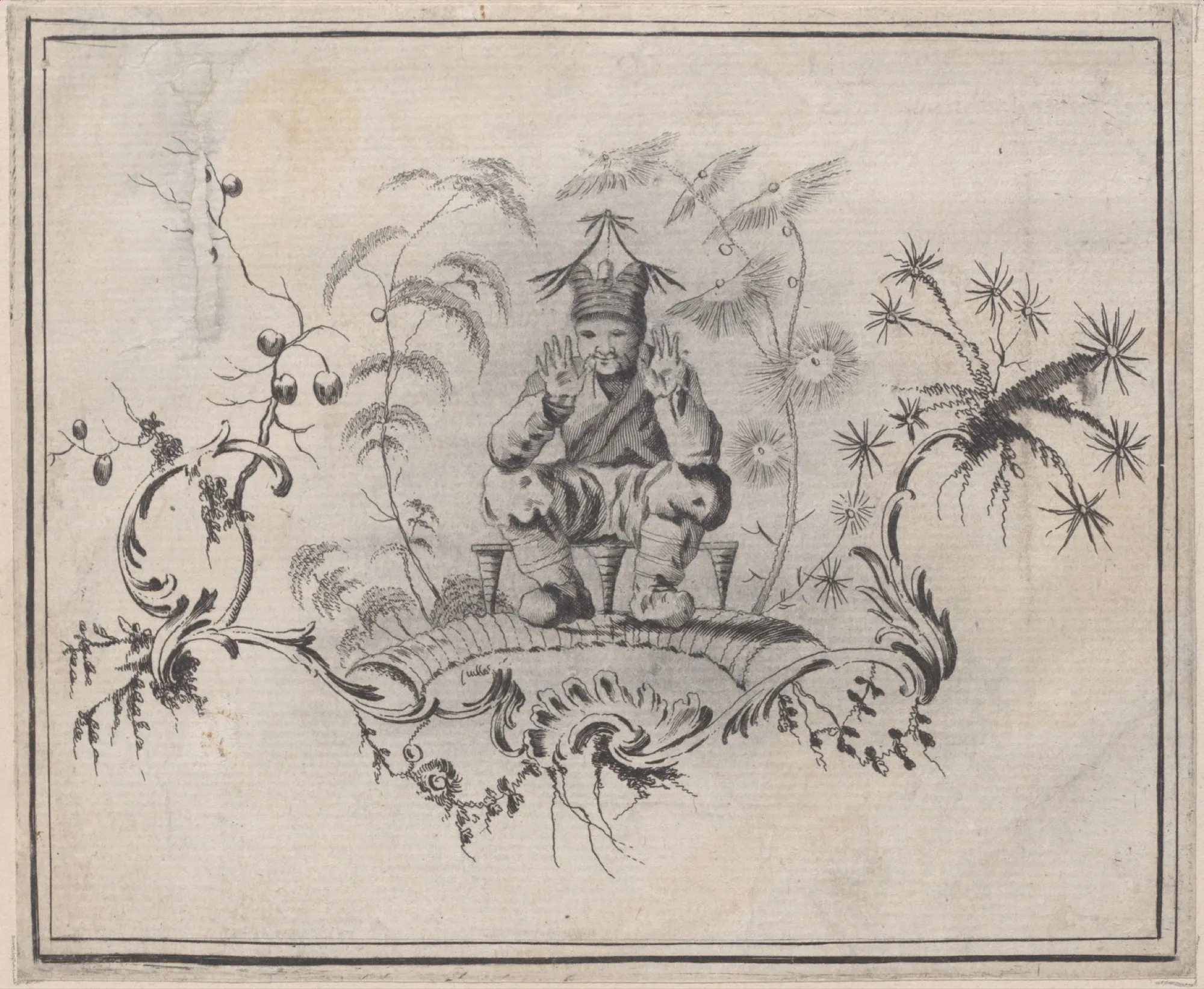
03 / Pattern
The figure becomes a motif
Jean Pillement’s chinoiserie designs circulated through prints that decorators could adapt across rooms, textiles, ceramics, and furniture. Reproduction loosened the imagery from any single object or place and turned “China” into a flexible design resource.
Close readingA costumed figure sits on an impossible bridge of shells, leaves, and scrolls. The shallow vignette offers no coherent geography; body, plant, and rococo ornament meet as interchangeable parts of an appealing pattern.
Open source record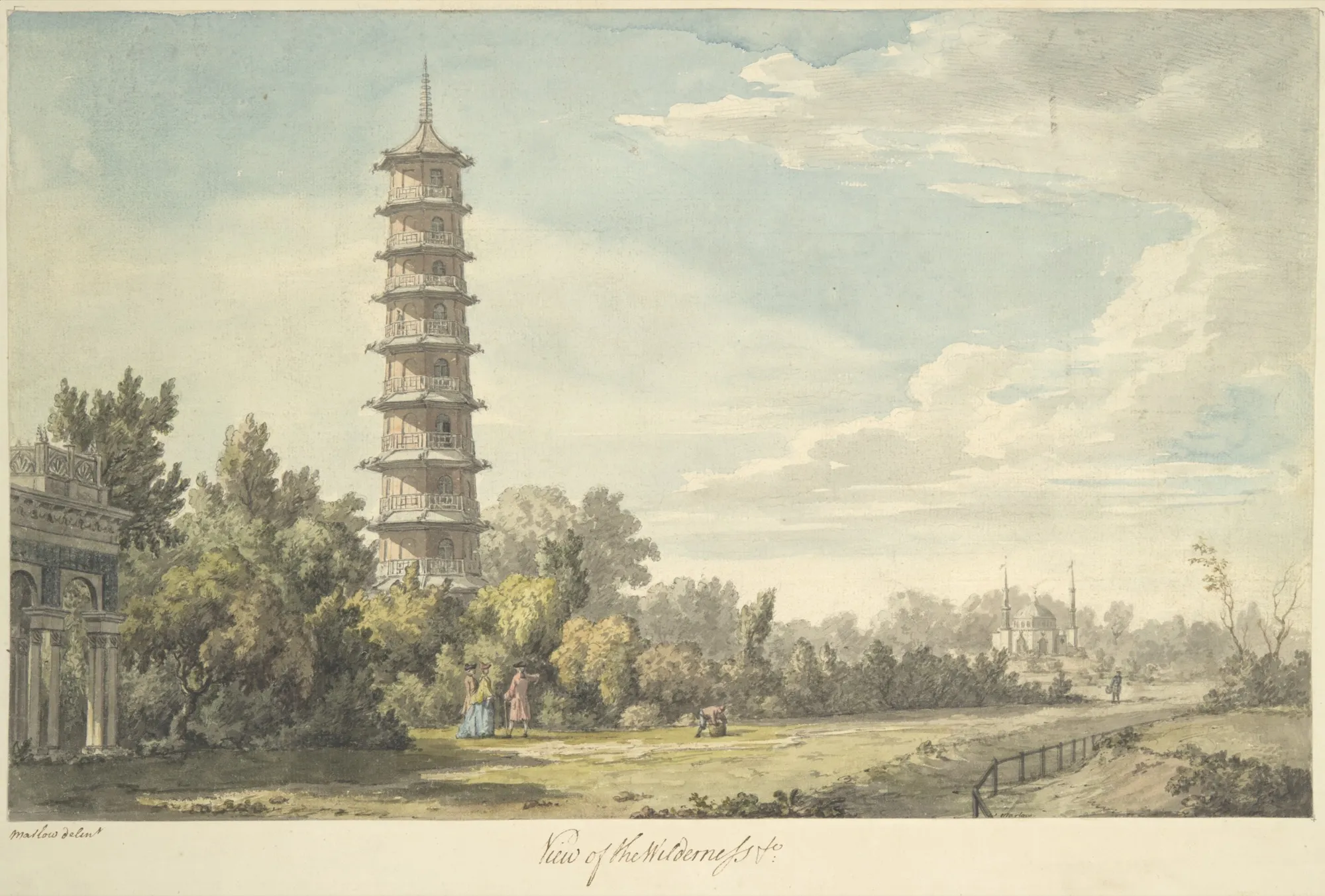
04 / Landscape
The motif becomes a place
William Chambers drew on visits to Canton when designing the Great Pagoda at Kew, while William Marlow’s view placed it inside a royal garden of global architectural references. China had expanded from an imported possession into an environment through which visitors could walk.
Close readingThe pagoda dominates the horizon beside the Alhambra, with a mosque in the distance. Arranged as picturesque accents in an English landscape, the buildings turn cultural difference into a collection under royal command.
Open source recordCounter-reading
Luxury did not mean knowledge
The luxury China of eighteenth-century Europe depended on skilled, responsive production and vast commercial systems. Its beautiful surfaces also made those relations easy to overlook—and admiration could coexist with condescension.
- 01Chinese artisans and merchants actively redesigned goods for foreign consumers, yet surviving European catalogues often reduce their work to anonymous “export” production.
- 02Tea, porcelain, lacquer, silver, and sugar met in the European interior through East India companies, colonial monopoly, and enslaved Atlantic labour that the finished objects rarely disclose.
- 03The same condensed signs that made China charming decoration could make it instant caricature; Gillray imagined the Qing court as grotesque before Macartney’s embassy had reached Beijing.
Evidence register
Sources in this chapter
- 01CoffeepotUnknown Chinese porcelain makersca. 1710A Chinese vessel adapted to a European drink
- 02Design for a Chinese-style Lacquer CabinetAnonymous German designer, in the manner of Martin Schnellca. 1720–30China expands from imported surface to European room
- 03Chinoiserie OrnamentJean Pillementca. 1760–85China becomes transferable ornament
- 04View of the Wilderness at KewWilliam Marlow; architecture by Sir William Chambers1763China reorganises a royal landscape
- 05TeapotMeissen Manufactoryca. 1735–40Imitation becomes court industry
- 06The Reception of the Diplomatique and his Suite at the Court of PekinJames Gillray; published by Hannah Humphrey14 September 1792Luxury fantasy turns diplomatic satire