Chapter 03 · 1687–1700
Model Empire
Jesuit books turned China into a European argument for rule by learning, moral example, and disciplined knowledge.
The 1687 Latin Confucius did more than translate a set of classical texts. Together with missionary reports, royal portraits, scientific images, and philosophical compilations, it gave European readers a China that could be admired as an ancient moral and political order. That model was assembled for specific religious and intellectual purposes; it was never a neutral description.
Evidence set6 objects · 1687–1700
Method noteThese objects move from a translated sage to a learned sovereign, a state observatory, and a European programme of exchange. Their sequence shows an ideal being built—not a transparent China being discovered.
The evidence sequence
How China became a political ideal
Scroll through 4 surviving objects. The image changes as the argument advances from one frame to the next.
01 / Sage
The sage becomes a philosopher
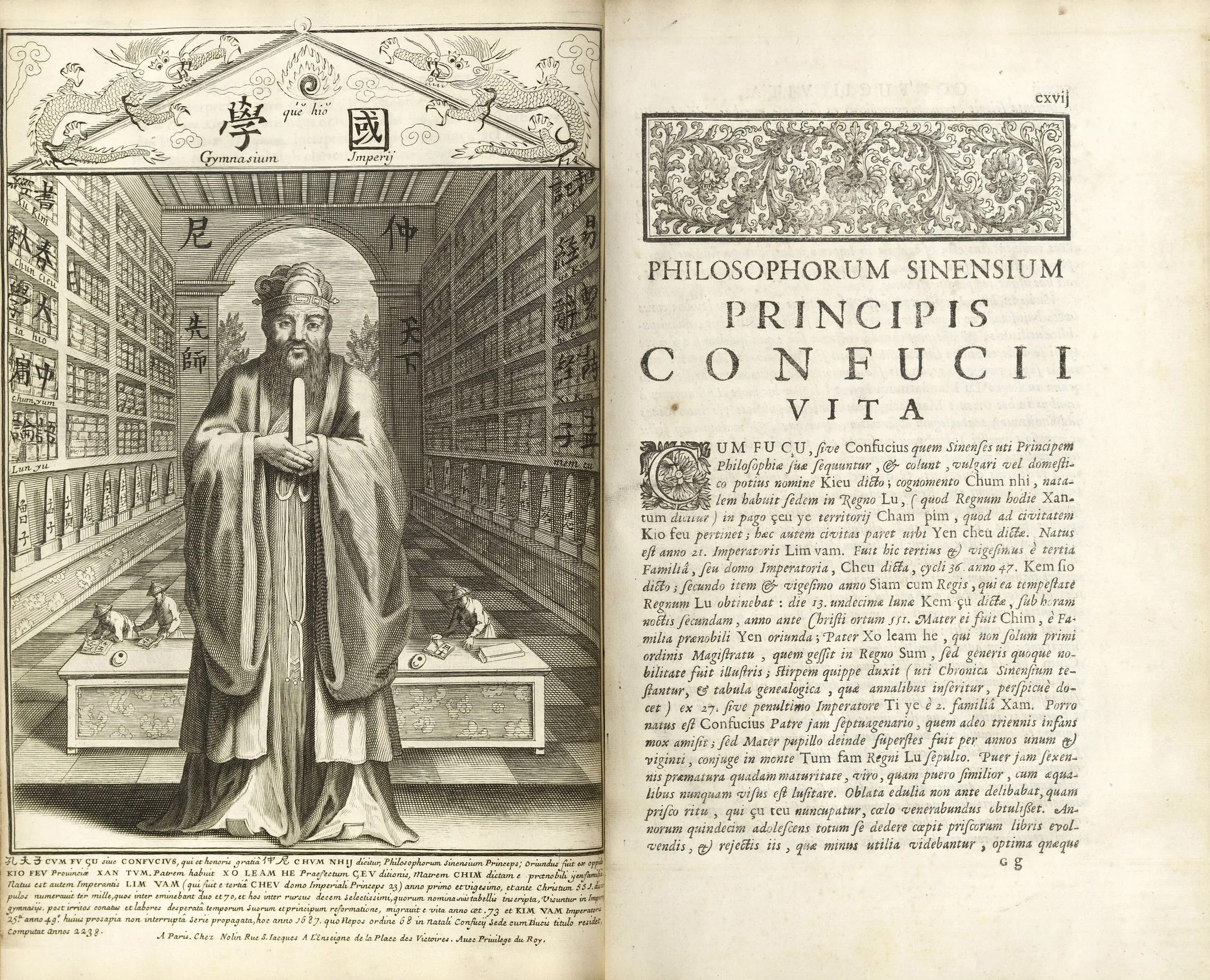
The Jesuit editors of Confucius Sinarum Philosophus presented Confucian texts and a life of Confucius in Latin. The title itself placed a Chinese teacher inside a European category—philosopher—and made classical ethics available as evidence of an ancient, rational moral order.
Close readingConfucius sits within a temple-like library while the facing page begins his Latin biography. Architecture, books, and scholarly pose turn translation into a portrait of learned authority; the image helps the European label feel self-evident.
Open source record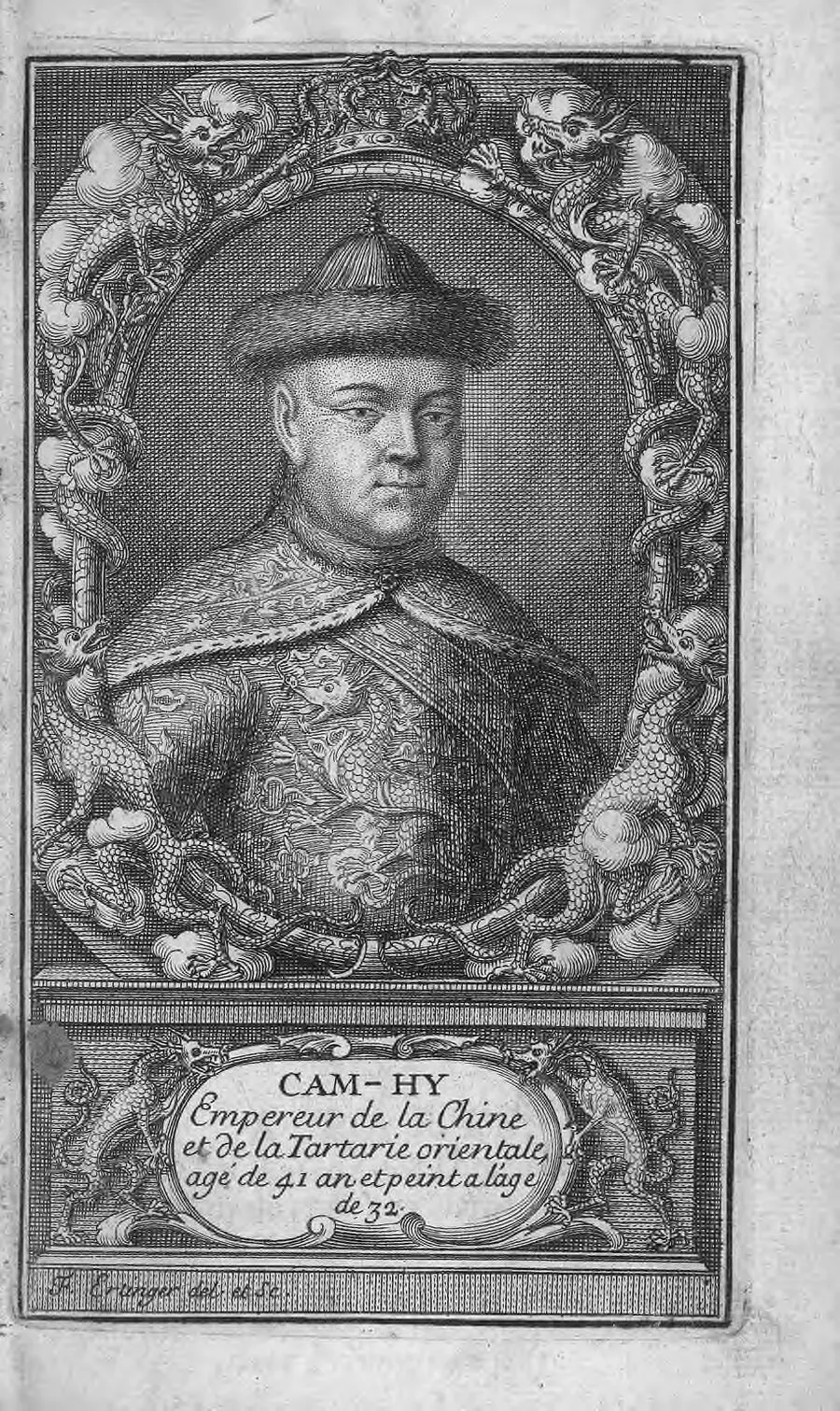
02 / Sovereign
The emperor becomes a scholar-king
Louis Le Comte’s account and Franz Ertinger’s engraving offered Kangxi as the human centre of an ordered empire. Missionary descriptions emphasised his curiosity, discipline, and support for mathematical learning, qualities that could be read in Europe as the virtues of a philosopher-king.
Close readingDragons, clouds, and an oval frame manufacture imperial splendour in a French print. The caption says the emperor was forty-one but pictured at thirty-two—a small admission that this authoritative likeness was already a copy, separated from its living subject.
Open source record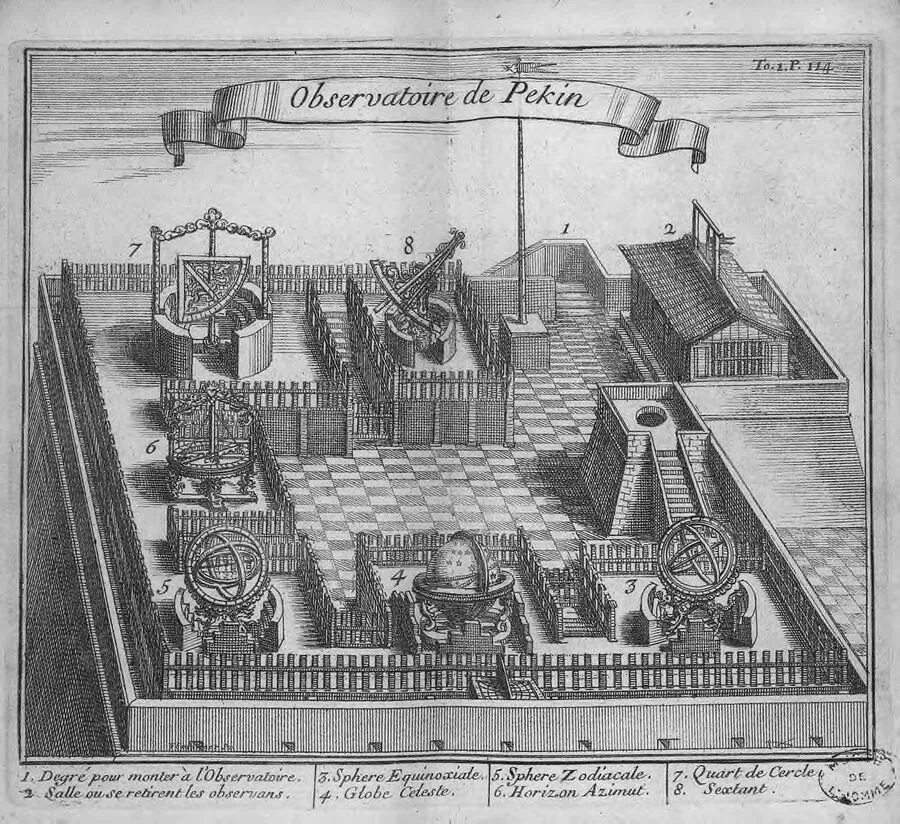
03 / Science
Knowledge becomes government
Jesuit mathematical service at the Qing court joined astronomy to administration. Le Comte’s view of the Beijing observatory turned that collaboration into visible proof: the empire appeared capable of gathering foreign expertise, monumentalising it, and placing it in the service of rule.
Close readingA numbered inventory makes the rooftop legible as a system, while dragon-shaped supports bind European instruments to Qing imperial imagery. The print presents science and sovereignty as one carefully ordered ensemble.
Open source record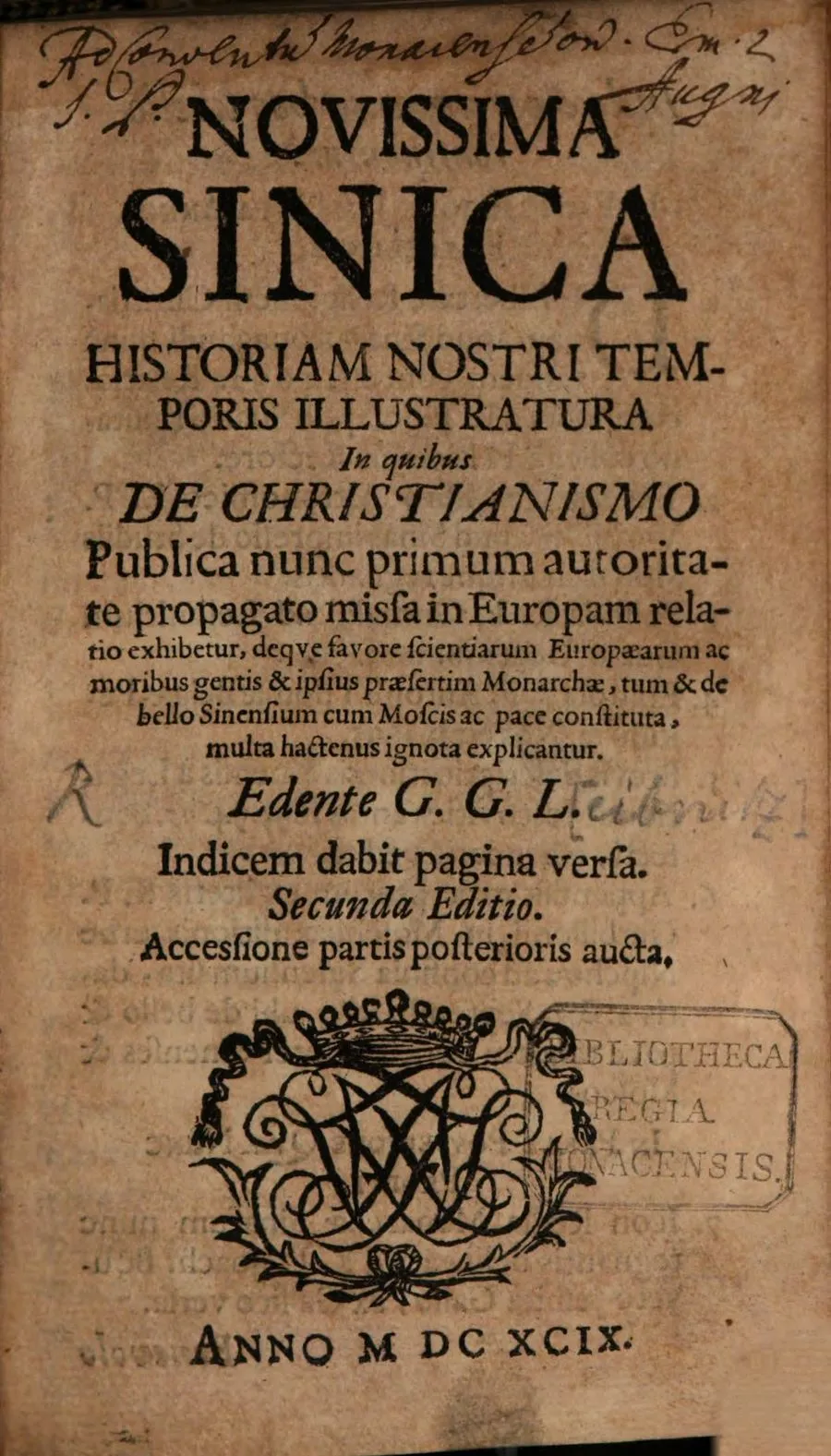
04 / Exchange
China becomes Europe’s interlocutor
Gottfried Wilhelm Leibniz assembled missionary letters and reports into Novissima Sinica. He treated China as more than an object of curiosity: its political ethics and Europe’s sciences could illuminate one another, making exchange between learned civilisations a philosophical project.
Close readingThe title page announces its editorial programme in miniature—Christianity, European sciences, the people and monarch, and war with Muscovy. Even a plea for reciprocal learning arrives through a European sequence of priorities.
Open source recordCounter-reading
The ideal was also a missionary argument
“Model empire” was not a seventeenth-century consensus. It was a persuasive frame built from selected texts, court access, and an accommodation strategy that soon became a theological controversy.
- 01Jesuit translators foregrounded elite classical ethics and interpreted Chinese terms in ways that could support the antiquity of natural religion and the legitimacy of their mission.
- 02Portraits, diagrams, and compilations condensed Chinese collaborators, institutions, and disagreements into forms that European print culture could recognise and circulate.
- 03The Paris Faculty of Theology’s 1700 censure—and an immediate pamphlet refuting it—shows that praise of Chinese antiquity and rites was being fought over, not simply accepted.
Evidence register
Sources in this chapter
- 01The life of Confucius in LatinProspero Intorcetta, Philippe Couplet, Christian Herdtrich, François de Rougemont, and collaborators1687Chinese philosophy translated for Europe
- 02Cam-Hy, Emperor of China and Eastern TartaryFranz Ertinger; published with text by Louis Le Comte1697The philosopher-king as portrait
- 03Observatoire de PekinFranz Ertinger; published with text by Louis Le Comte1697Science as state order
- 04Novissima Sinica, second editionGottfried Wilhelm Leibniz, editor1699China as a reciprocal civilization
- 05The throne of the Emperor of ChinaFranz Ertinger; published with text by Louis Le Comte1697Ordered sovereignty
- 06Censure de quelques propositions des PP. Le Comte et Le Gobien JésuitesAnonymous1700The model empire becomes a controversy