Chapter 07 · 1911–1949
Revolution and Ally
The republic did not settle what China was to the West. Western publication, news photography, and wartime propaganda repeatedly recast it as an awakening nation, a fragmented arena, a heroic resister, and a democratic ally—identities shaped as much by Western needs as by events in China.
The 1911 Revolution ended Qing rule but did not produce a single, stable successor. The early republic gave way to competing military governments, Nationalist consolidation, Communist revolution, and renewed foreign pressure. Japan’s invasion then transformed the international field. China, long pictured as weak or menacing, could become a victim of aggression and—after the United States entered the Pacific war—an indispensable ally. The new friendship recognised Chinese resistance, but its images selected a China that Western publics could quickly read.
Evidence set6 objects · 1912–1943
Method noteThe sequence follows four acts of renaming: awakening, fragmentation, resistance, and alliance. The first two make republican China a problem of development and order; the second two make its long war useful to an Allied story of endurance, freedom, and shared democracy.
The evidence sequence
How a republic became a wartime friend
Scroll through 4 surviving objects. The image changes as the argument advances from one frame to the next.
01 / Awakening
Revolution becomes awakening
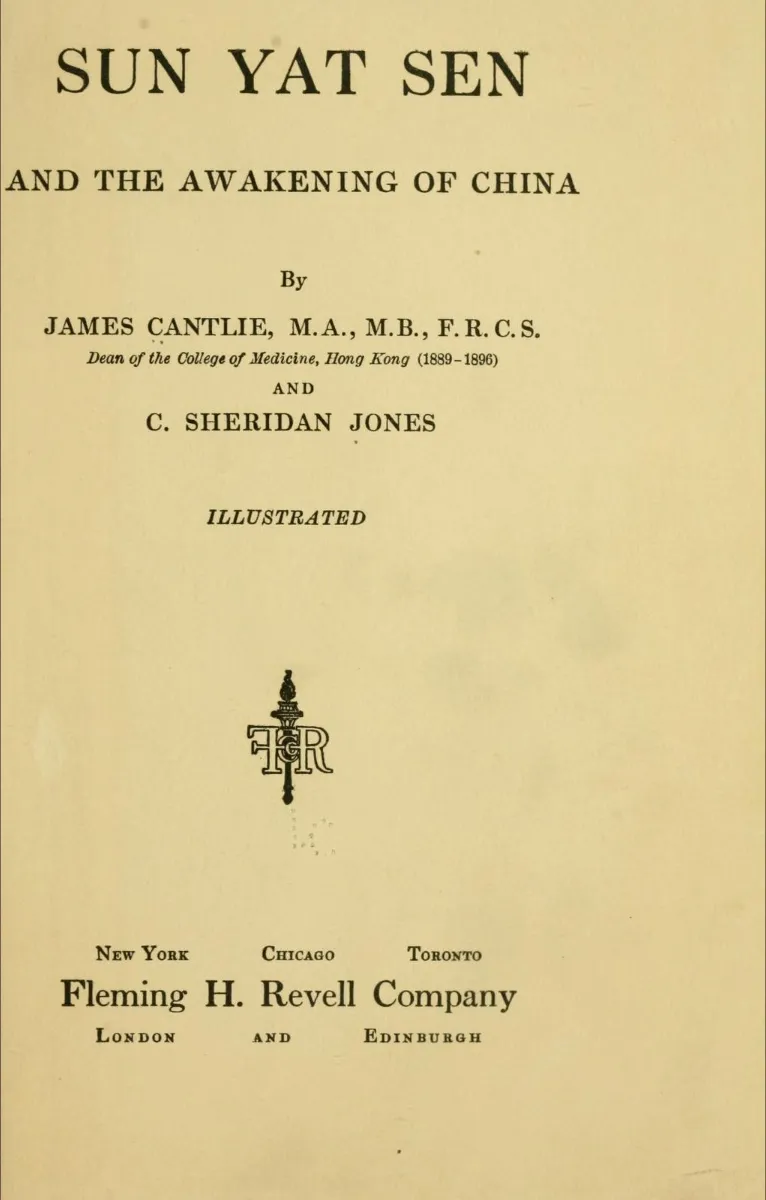
Published immediately after the 1911 Revolution, James Cantlie and C. Sheridan Jones’s English-language biography organised political rupture around Sun Yat-sen and a single temporal metaphor. China had not simply changed governments; it had awakened.
Close readingThe title page gives “SUN YAT SEN” the largest type and places “THE AWAKENING OF CHINA” directly beneath his name. A crowded revolution becomes the work of a recognisable individual, while “awakening” assigns China a position on a developmental clock whose terms the book already knows.
Open source record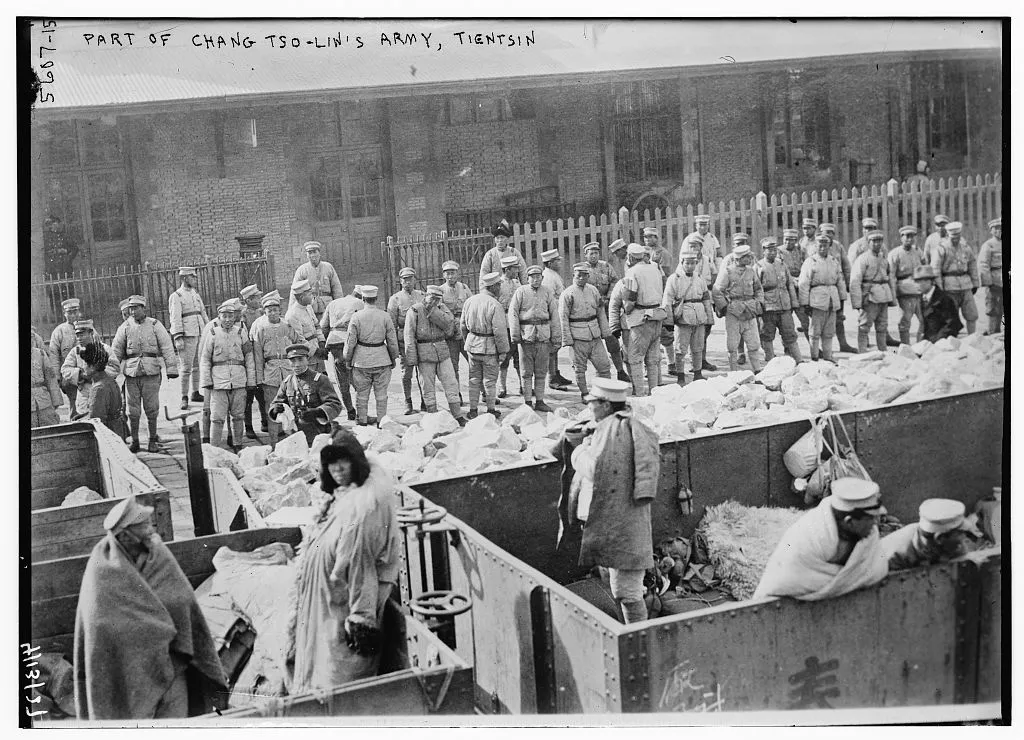
02 / Fragmentation
Republic becomes armies
By the early 1920s, the promise of a unified republic competed with rival governments and regional military power. The Bain News Service recorded troops belonging to Zhang Zuolin at Tianjin. Its concise caption makes the political field legible through a commander and his men rather than through republican institutions.
Close readingSoldiers form an uneven line behind freight wagons while workers and other figures interrupt the foreground. Rail, labour, military presence, and an urban crowd share the negative, yet the handwritten title fixes attention on “Chang Tso-Lin’s Army.” Complexity is gathered under the name of a warlord.
Open source record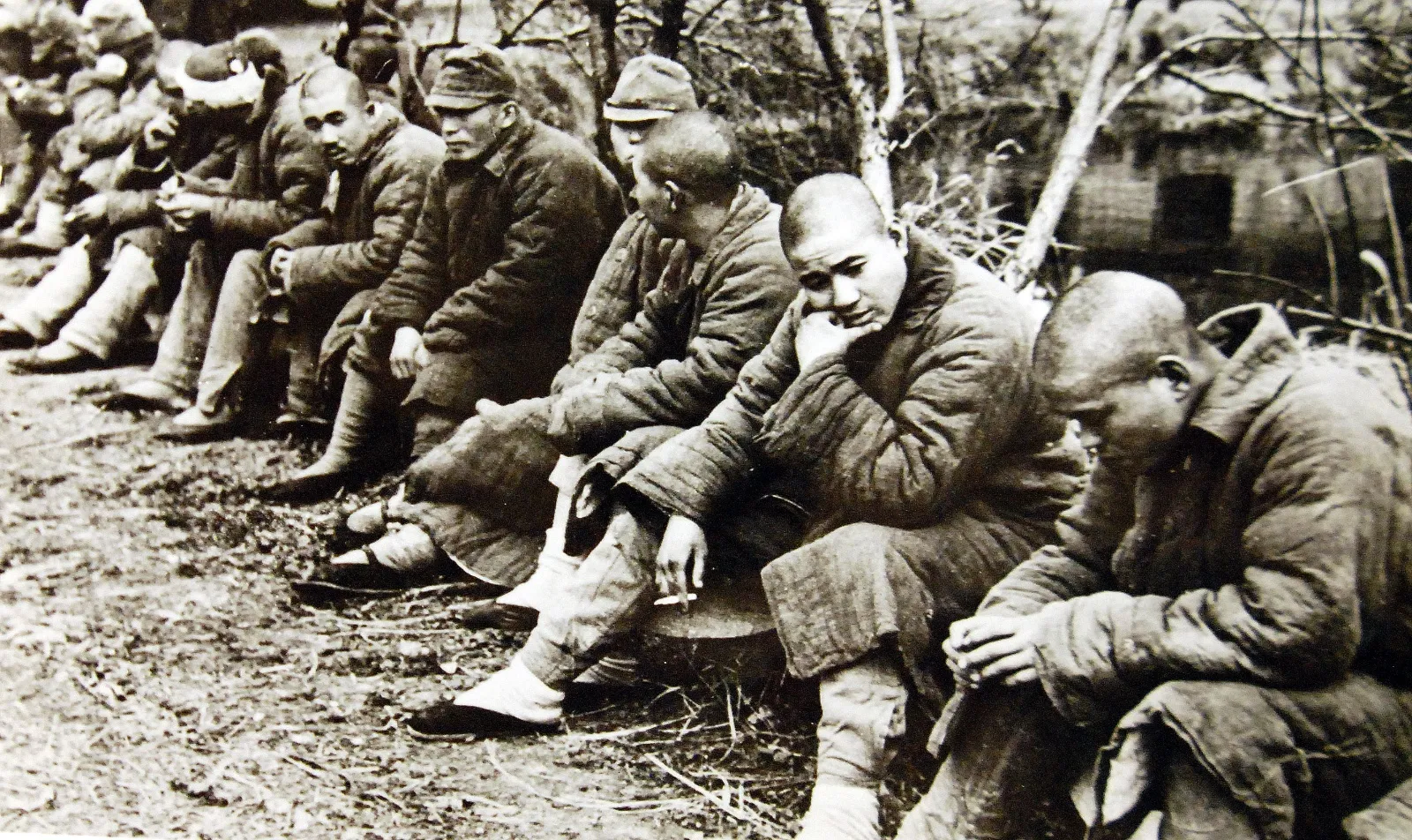
03 / Resistance
Victim becomes resister
China had already endured years of Japanese invasion when the United States entered the Pacific war. Released after the Chinese victory at Changsha, this Office of War Information photograph presented resistance as proof that a materially disadvantaged ally could still fight on.
Close readingThe visible subjects are captured Japanese soldiers, seated in a receding row. Chinese troops are present only through the caption and the fact of capture. “Against all odds” supplies the absent national protagonist, joining military agency to an established story of China as outmatched and suffering.
Open source record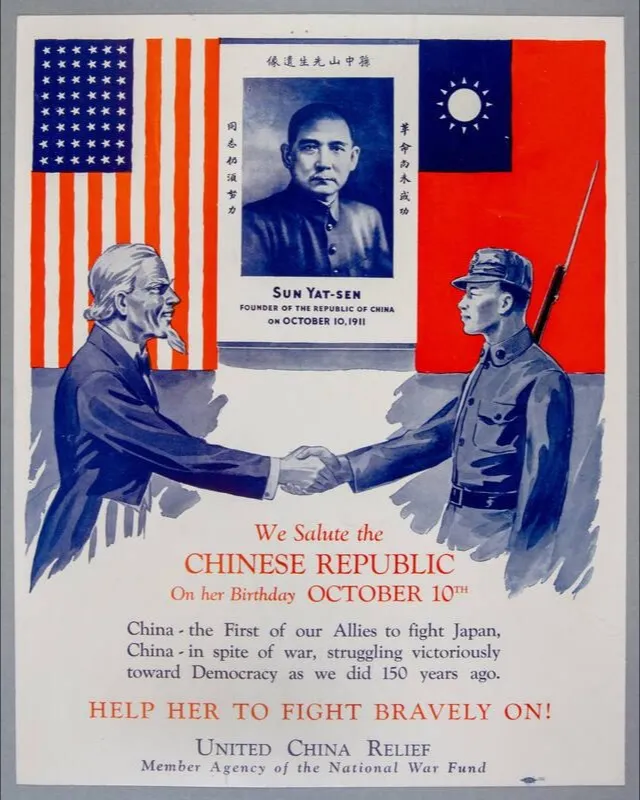
04 / Alliance
Ally becomes mirror
United China Relief’s poster celebrates the republic as “the First of our Allies to fight Japan” and asks Americans to help it continue. Recognition comes through a comparison: China is said to be struggling toward democracy as the United States had done 150 years earlier.
Close readingThe two flags occupy equal fields and the central handshake crosses their boundary. Above it, Sun Yat-sen supplies a founding ancestor for the republic. Yet Uncle Sam is the older civilian and China the armed young man; the poster’s apparent symmetry still places one national history in the position of measuring the other.
Open source recordCounter-reading
The alliance was real; its image was partial
China’s long resistance materially shaped the war against Japan, and Chinese diplomats actively used the alliance to pursue aid, status, and changes in discriminatory treatment. Wartime imagery nevertheless selected an anonymous Nationalist soldier and a highly recognisable elite envoy as the faces through which American audiences would meet a politically divided country.
- 01China had fought Japan for years before Pearl Harbor. The Office of War Information did not create Chinese resistance, but its caption turned that history into an American morale form—an under-equipped ally “against all odds.”
- 02“This man is your friend” temporarily reversed the visual grammar of racial exclusion. It made the Chinese soldier familiar through a friend-or-enemy binary while federal exclusion was only partially dismantled and unequal immigration quotas remained.
- 03Soong Mei-ling’s White House portrait records genuine diplomatic agency, but the very fluency that made her effective also made one Nationalist, Christian, English-speaking elite stand for a country containing many armies, parties, regions, and civilian experiences.
Evidence register
Sources in this chapter
- 01Sun Yat Sen and the Awakening of ChinaJames Cantlie and Charles Sheridan Jones1912Revolution translated as a national awakening
- 02Part of Chang Tso-Lin’s Army, TientsinBain News Servicec. 1920–1925The republic condensed into a warlord’s troops
- 03China fights on against all oddsUnited States Office of War Information; photographer unknownJanuary 1942Chinese victory narrated as heroic endurance
- 04We salute the Chinese Republic on her birthday October 10thUnited China Reliefc. 1943–1945Alliance maps Chinese history onto American democracy
- 05This man is your friend: Chinese: he fights for freedomUnited States Office of Facts and Figures, Graphics Division1942National difference recoded as wartime friendship
- 06Washington, D.C. Madame Chiang Kai-shek and Mrs. RooseveltRoberts24 February 1943Diplomatic intimacy gives wartime China a recognisable face